

This text is one that students actually don’t sell back to the bookstore when the semester is over! It is one of the best texts I have ever seen and love it. It is especially amazing for teaching students surface anatomy. Plus, the videos make my job so much easier.”
Why do 2,700 manual therapy programs prefer Trail Guide to the Body?
Sets instructors up for success.
Trail Guide to the Body, the gold standard in palpatory anatomy, transforms the classroom into a rich learning environment. Every element of this best-selling textbook–from its lifelike and detailed anatomical illustrations to the compelling, easy-to-grasp instructions and descriptions–has helped instructors deliver lessons in powerful, memorable ways. All of which makes it easier for you to deepen students’ mastery of musculoskeletal anatomy and palpation, and raise the bar for student achievement.
See table of contents.
See instructor tools.
See textbook details.
See eTextbook details.
See student tools.
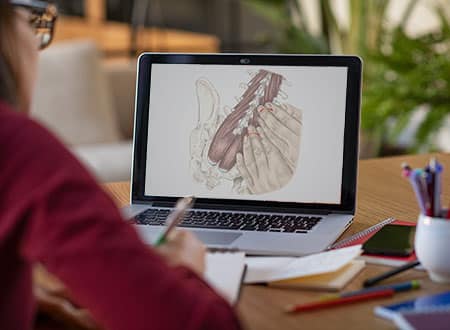
Takes students on a confidence-building learning journey.
What makes author Andrew Biel’s Trail Guide to the Body a great confidence builder? There is a science to it.
It starts with content written in a simple, engaging way–beginning with chapter pre-learning stories that presents the “why?” context, motivating students to dig deeper into assigned topics. Next, the text takes students on a journey that includes a clearly defined, step-by-step trail through musculoskeletal structures, enhancing their understanding of how to navigate the human body, which is critical for effective assessment. Finally, there are eye-catching, full-color visuals and accompanying tutorial videos that take the mystery out of practicing and learning palpation, making it the perfect muscle palpation guide.
Combined, these ingredients help students build the knowledge, skill, and confidence needed to become successful manual therapy professionals.

Comes with resources for quickly creating dynamic lessons.
As a Trail Guide to the Body educator, you’ll gain easy access to a full suite of resources that help you create dynamic, multi-faceted lessons with ease. From multiple PowerPoint presentations and a vast image library to unique classroom activities, these resources save you time and capture your students’ attention.

Expand student learning beyond the classroom with tools that can go anywhere.
By owning Trail Guide to the Body, students gain exclusive access to an empowering repository of study tools, most included for free. All-new, easy-to-access palpation videos on how to identify and palpate more than 90 essential muscles, including how to locate 24 bony landmarks, overlay images, interactive mobile apps, and more are available online for students.
“This is just to say THANK YOU for the videos and other supplementary material on the website. I’ve been studying with the Trail Guide to the Body, and I’m so pleased to have discovered these resources that are an excellent partner to the book. They’re really deepening and ‘locking in’ what I’ve been reading and exploring. I particularly like the videos showing palpation with overlays of the various structures in 3-D. Many ‘ah-ha’ moments! My Anatomy & Physiology course is feeling so much more ‘do-able’ now!”
Harrie Frost
Trail Guide to the Body student, Bowen College, UK

Trail Guide to the Body, 7th edition
For more than two decades, the Trail Guide to the Body muscle palpation guide has helped instructors deliver lessons in clear and memorable ways. With this newest edition, it will be even easier to deepen students’ understanding of surface anatomy and mastery of palpation.
Here’s what’s new in the 7th edition:
1. All-new palpation videos for learning beyond
the page
All-new palpation instruction videos bring palpatory
anatomy to life.
- Nearly 80 videos detail how to identify and palpate
more than 90 essential muscles. - Now includes videos for locating 24 bony landmarks.
Available via eTextbook links and apps.
2. A beginner’s orientation to the nervous system
All-new 18-page primer—Appendix A: A Day in the Life of Your Nervous System.
Combines storytelling with 36 vivid visuals to make complex concepts stick.
3. AOIN tables grounded in daily actions
Expanded “When Do You User Your ____ Muscles” connects muscles to everyday movements.
4. Updated origin and insertion illustrations
The black and red colors for the Origin and Insertion illustrations have been switched to more closely align with classroom skeletal models.
5. Enhanced feature boxes to spark curiosity
Palpation Plus: Insider tips for accuracy and comfort.
Discover More: Intriguing facts to keep learners engaged.
Comparative Anatomy: Interesting cross-species comparisons to reignite attention.
6. Dynamic new chapter openings
Eye-catching body-in-motion illustrations tied to chapter focus.
Engaging “See for yourself” activities to get students moving and exploring.
7. Easier navigation from page one
Redesigned “How to Use This Book” for quicker student onboarding.
Refreshed Chapter 1 to help learners navigate the body confidently from day one.
8. Updated index
Streamlined index for easier navigation

Trail Guide to the Body, along with all its associated student and instructor resources, has greatly assisted our DPT students in the transition to hands-on, clinical course work. It has routinely proven to be an invaluable component of our clinical courses in our early DPT curriculum.”