

This text is one that students actually don’t sell back to the bookstore when the semester is over! It is one of the best texts I have ever seen and love it. It is especially amazing for teaching students surface anatomy. Plus, the videos make my job so much easier.”
The #1 choice for professional
athletic training education programs.
Trail Guide the Body: Required by 80% of AT programs.
With widely vetted, easy-to-absorb, and engaging content, Trail Guide to the Body has become one of the most respected resources for programs educating future athletic trainers. Along with eye-catching, full-color visuals to help visualize muscles, this “gold standard” textbook enhances students’ understanding of how to navigate anatomical structures of the human body and helps them develop the fine palpation skills needed for competent clinical assessment.
Makes Learning Anatomy & Palpation Enjoyable
When surface anatomy and palpation courses are dry, complex, and a hurdle for many students to clear, morale dips and student retention can suffer. Adopting this textbook makes learning surface anatomy and palpation not just manageable, but enjoyable, elevating your AT program’s quality.
Takes Students on a Confidence-Building Learning Journey
With Trail Guide to the Body, anatomy class become a hub of discovery, filled with genuine “a-ha!” moments. The best-selling textbook takes AT students on a clearly defined, step-by-step trail through musculoskeletal structures.
Expands Learning Beyond the Classroom
By owning Trail Guide to the Body, your students gain exclusive access to an empowering repository of study tools that help solidify their understanding of coursework. Convenient, free, and easy-to-access palpation videos, overlay images, and more are available online.
Trail Guide to the Body Takes Another Leap Forward with the 7th Edition
- Nearly 80 brand-new videos that detail how to identify and palpate more than 90 essential muscles—including how to locate 24 bony landmarks
- Expanded “When Do You User Your ______ Muscles, connecting to everyday movements
- A beginner’s orientation to the nervous system with a new 18-page primer
- Updated origin and insertion illustrations: Colors for the Origin and Insertion illustrations have been switched to more closely align with classroom skeletal models

Joint Anatomy for Athletic Training: Trail Guide to the Body’s Clinical Companion
Designed as a companion to Trail Guide to the Body and created for AT students, Joint Anatomy for Athletic Training® dives deep into the structure of joints and their related components. The eTextbook follows, chapter by chapter, the body regions detailed in Trail Guide to the Body and features succinct descriptions of joints ATs most commonly treat.
Improves Retention with Interactive Visual Learning
Joint Anatomy for Athletic Training includes 41 new movement videos and over 190 detailed joint anatomy illustrations to help students visualize complex joint structures—ligaments, tendons, bursae, surrounding soft tissue. This interactive eTextbook aims to increase students’ retention and confidence in recognizing and assessing joint injuries.
Features engaging student resources—built right into the eTextbook!
Created for AT students, the eTextbook expands learning beyond the classroom with tools that can go anywhere:
- Clinically relevant scenarios and interactive examples
- Chapter-opening questions that act as a bridge between what students already know and what they are about to learn
- Hyperlinked definitions and key concepts available in a single click
- “Connecting the Dots” encourages students to reflect on clinical examples of the concepts they have just read about
- Linking It All Together at the end of each chapter revisits chapter-opening questions to inspire deeper classroom discussion
- Anchoring Brain Builders for students to test what they’ve learned or what material needs revisiting
- “What’s in a Name” explains why a structure is named what it is to assist in student retention

Trail Guide to Movement: Bring the Subject of Human Movement Alive!
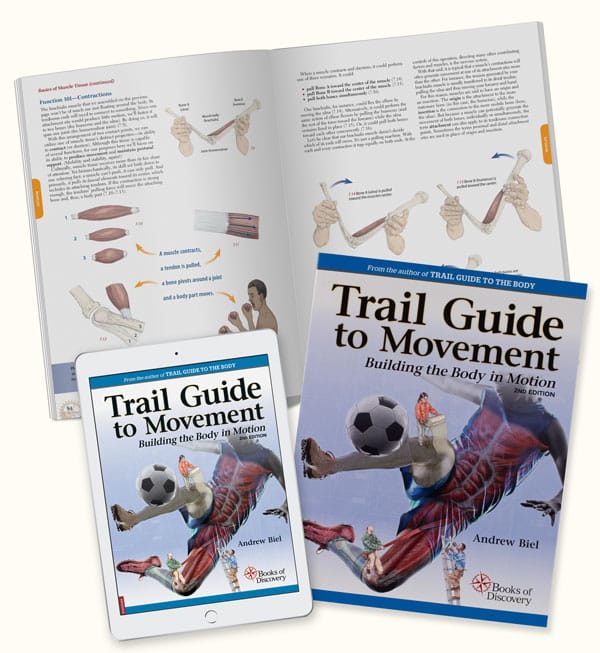
With captivating illustrations and clear descriptions of kinesiological principles, Trail Guide to Movement® takes the kinesiology principles found in Trail Guide to the Body even further. It deepens students’ understanding of how muscles, bones, fascia, joints, and other structures come together to produce human movement.
Takes Students on a Fascinating Journey into Human Movement
Winner of a gold medal in the PubWest Book Design Awards and written in the same easy-to-understand, encouraging voice and subtle humor as Trail Guide to the Body, Trail Guide to Movement explores biomechanics, key structures for movement, and principles of posture and gait, all with memorable imagery and straightforward descriptions.
Studying Can Take Place Anywhere, Anytime
With Trail Guide to Movement eTextbook, students can bookmark pages, enlarge images, highlight text, make notes, and easily search for a term they’re looking for — making it easier for them to study and ace exams!
For 25 years, I searched for a text that would help my student therapists understand anatomy using their own body as a ‘supplemental text.’ Of all the texts I have used, I have never seen an anatomy text as practical and as hands-on as Trail Guide to the Body. The illustrations are superb. This text is a must for the therapy student who is serious about learning hands-on anatomy.”
Other items to consider.
 Instructor Resources
 Instructor Resources
As a Trail Guide to the Body educator, you’ll gain access to a powerhouse collection of complimentary instructor resources for every lesson and every type of learning style. From PowerPoint presentations and image libraries to classroom activities, these resources will save you time and capture students’ attention like never before.
 Trail Guide to Movement
 Trail Guide to Movement
Author Andrew Biel takes students on a unique and fascinating journey as he helps build — step by step — a human body in motion. Topics include key physiological elements of movement and biomechanical principles.